



If you’ve logged enough miles to have an elite status card in your wallet, you’ve almost certainly noticed it, that quiet, slightly rigid posture flight attendants adopt the moment the plane begins its takeoff roll. Hands tucked underneath them, eyes forward, perfectly still. It can look a little unsettling if you don’t know what’s going on. Have you wondered why they do it? Is it just a standard posture or is there more to it? An article by CN Traveler provides some more insight into this.
Flight Attendants: The brace position, explained simply
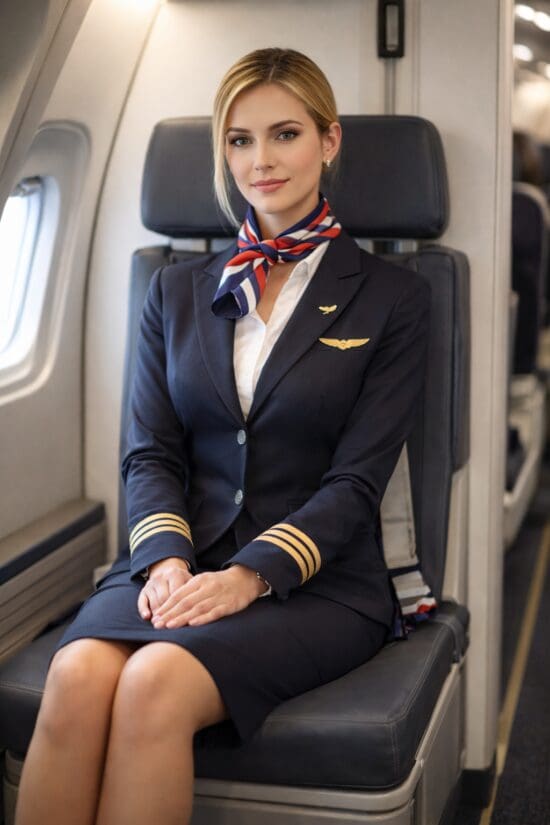
Aviation has a name for it: the brace position. For flight attendants, it’s a carefully calibrated posture designed to protect the body during the two most statistically eventful phases of any flight, takeoff and landing. Sitting on the hands is one of the most common variations, keeping the arms secured close to the body to minimize impact risk. The exact position varies depending on whether a jump seat faces forward or rear-facing, and the type of harness system involved.
What looks like passive waiting is actually active preparation. While seated, cabin crew run through a silent mental checklist, what Ocampo describes as a “silent review.” Think of it as a preflight checklist happening in real time, in plain sight, while the engines spool up.
What’s on that mental checklist?
✓ Location and operation of every emergency exit on that specific aircraft
✓ Identifying passengers who may be able to assist in an emergency (yes, they’re sizing up the cabin)
✓ Rehearsing the exact commands to use during different emergency scenarios
✓ Confirming the location of evacuation equipment — slides, life vests, oxygen
What does this mean for you as a passenger?
You’re not required to mimic the brace position on every flight. However, if the crew instructs you to assume one, whether in a planned or unplanned emergency, you’ll want to know what to do without fumbling for instructions mid-crisis.
That safety card in the seat back pocket? Read it. Every time. Even if you’ve flown this aircraft type a hundred times. Ocampo is direct: “In a planned emergency, flight attendants will brief passengers on what to do. During an unplanned emergency, they may not have time to do so.” The card is your insurance policy.
The Pundit’s Mantra
Frequent fliers are often the worst offenders here, headphones in, laptop open, safety demo ignored. However, here’s a perspective worth internalizing: different aircraft types, different cabin configurations and even different seat classes can mean meaningfully different emergency procedures. The crew isn’t going through the motions just as a routine. They’re giving you information that is genuinely specific to that aircraft, that flight, at that moment.
Cabin crew are certified safety professionals, not just employees in the hospitality industry. The time they put into their silent review during your takeoff roll reflects training that most passengers will never fully appreciate. So, whether you’re a newbie or a frequent traveler, it only takes a few seconds to listen in, pay attention and takes some mental notes of the instructions given out by flight attendants during your flight.
As a frequent flyer, do you pay attention to routine announcements and procedures during each and every flight? Tell us in the comments section.
___________________________________________________________________________________________________________________
Credit Card Offers
American Express Business Credit Cards
- Earn Up To 300,000 Membership Rewards points with the Business Platinum Card!
- Earn Up To 200,000 Membership Rewards points with the Business Gold Card by American Express
Chase Sapphire Cards
- 75,000 Chase Ultimate Rewards points up for grabs with the Chase Sapphire Preferred Card!
- Earn 125,000 bonus points with the Chase Sapphire Reserve Card
- Earn 150,000 bonus points with the Chase Sapphire Reserve Card for Business Card
- Chase Ink Business Preferred Card offering a limited time welcome bonus of 100,000 points






Very so interesting
Before heading to the airport I prepare for the worst by wearing clothing made of natural fibers leaving very little exposed skin. In a fire, time is your enemy. Cotton, wool, tencel and leather are your friends. Polyester is NOT your friend. It melts leaving debilitating burns even if it doesn’t ignite. A sport coat made of natural fibers can be used to cover your head to buy yourself precious time that could save your life. Once on board I always review the safety information card and commit to memory exactly what I’ll do in an emergency. I also memorize contingency plans. I never assume the cabin crew will be capable of rendering assistance.
Dial back on the AI pics. She’s not even wearing a seat belt. And it doesn’t even look like she’s seated by an exit
Thank you. I was s Flight Attendant for 31 years. Been retired for 5 years. It always amazed me how most people don’t pay attention to the safety demo. Doing so might just save your life. We are not glorified waitresses, but the first line of safety professionals. Happy travels to all.
@Scott: Thanks for reading and greatly appreciate the feedback. Safe Travels.