





People in the miles and points community are laser focused, or some may say, almost obssessed with squeezing value when it comes to planning their travel. So when searches for “AI travel planner” hit an all-time high in January, and 3 in 10 Americans said they’d use AI to plan their trips this year, I also decided to test it out. The verdict? It depends entirely on what you’re asking it to do. And most people are asking it to do the wrong things.
What Works Well With AI
If you’ve ever spent three hours in seventeen browser tabs trying to figure out the optimal Rome neighborhood for a four-night stay with two kids, a stroller and a budget hotel ceiling of $200/night, AI will get you to a solid answer in about ninety seconds. That’s not nothing. That’s genuinely a week’s worth of research compressed into a coffee break.
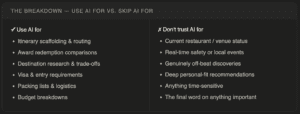
Itinerary scaffolding is legitimately excellent. “Nine days, mix of beaches and culture, I hate being rushed, partner hates museums”, if you enter this as your prompt, you’ll get back a sensible day-by-day skeleton you can actually work with. Want to swap days around? Done instantly. Add a food tour? It’ll find one. This kind of rapid iteration used to cost you either serious money (a good travel agent) or serious time (you, on TripAdvisor at midnight).
For points nerds specifically: AI is shockingly good at calculating award routing logic, identifying stopover options and explaining the fine print on transfer partner rules. I asked one to compare Avianca LifeMiles vs. Air Canada Aeroplan for a business class redemption to Tokyo and got a sharper breakdown than I’d have pulled together myself in 20 minutes.
Where Issues Still Persist
AI has a freshness problem and it’s worse than you think. The “amazing cocktail bar in Lisbon” it confidently recommends? Closed eight months ago. The “quiet, un-touristy neighborhood” in Barcelona? Discovered by a thousand Instagram reels since the training data was captured. AI doesn’t know what it doesn’t know and it almost never tells you when its information might be stale.
The personalization gap is also real and currently undersold. AI can ask you questions about budget and travel style, but it can’t pick up on the fact that you need a decent coffee within three minutes of waking up, that your travel partner has a deep fear of motorbikes, or that “boutique hotel” to you means something completely different than “boutique hotel” to the algorithm. The texture of how real humans experience places is something AI can describe, but cannot model for your specific situation.
Moreover, there’s a homogenization risk nobody’s talking about loudly enough. If millions of travelers are all generating itineraries from the same AI systems trained on the same tourism data, we’re all converging on the same “hidden gems”, which then promptly stop being hidden. The crowd-wisdom becomes an algorithm trap.
The Pundit’s Mantra
The travelers getting the most value from AI right now are using it like a very fast, very well-read research assistant, not a final authority. They use it to generate options, then verify those options against recent reviews, forums, and occasionally a human who’s actually been there in the last six months.
If you export an AI itinerary directly to your calendar without questioning it, you’re going to have a bad time eventually. Travel has always rewarded a certain amount of productive uncertainty. The best moments on any trip are almost never the ones the algorithm suggested. No AI has figured out how to model serendipity yet and long may that remain the case.
How do I use AI for travel planning? My favorite use is to sift through complicated terms and conditions, be it for credit card applications or flight cancellations. Whenever I have to decode any complex policy, I simply copy and paste it and ask for a succinct summary with the caveats. It saves me a ton of time as previously I had to read through all the terms and conditions on my own.
How do you use AI to help meet your travel needs? Tell us in the comments section.
___________________________________________________________________________________________________________________
Credit Card Offers
American Express Business Credit Cards
- Earn Up To 300,000 Membership Rewards points with the Business Platinum Card!
- Earn Up To 200,000 Membership Rewards points with the Business Gold Card by American Express
Chase Sapphire Cards
- 75,000 Chase Ultimate Rewards points up for grabs with the Chase Sapphire Preferred Card!
- Earn 125,000 bonus points with the Chase Sapphire Reserve Card
- Earn 150,000 bonus points with the Chase Sapphire Reserve Card for Business Card
- Chase Ink Business Preferred Card offering a limited time welcome bonus of 100,000 points







Great guide. I like how you explained both the useful side and the risks of AI trip planning. AI can be a big time-saver for creating a first draft itinerary, comparing destinations, and organizing travel ideas, but I agree that travelers should not rely on it blindly. Details like routes, opening hours, weather, ticket availability, prices, and local rules still need to be checked before booking. That’s the same practical approach I’m using with AITripWise.
Great guide. I agree that AI trip planning is useful, but it works best when travelers treat it as a planning assistant, not a final decision-maker.
From my experience, AI is very helpful for building a first-draft itinerary, comparing destinations, grouping nearby attractions, and giving ideas when you don’t know where to start. But before booking anything, travelers should still double-check opening hours, transport routes, local holidays, weather, ticket availability, and whether the daily schedule is realistic.
For 2026, I think the best way to use AI for travel is: let it create the rough plan, then verify everything manually with maps, official websites, and recent traveler reviews. That gives the speed of AI without losing the human judgment needed for a good trip.