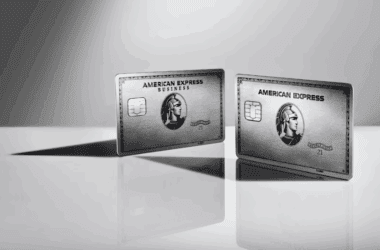


American Express has never been shy about charging high annual fees their cards. The company has built its entire brand on the premise that the price of admission is justified by what you receive in return. The new Graphite™ Business Cash Unlimited Card, however, doesn’t quite pass muster. It charges like a premium product, but doesn’t live up to what it promises.
The Graphite card launched in late March 2026 to considerable fanfare in the points and miles community. A new Amex business offering! A sleek name! A metal card option! However, when then the details emerged, the fanfare quieted to a polite murmur of concern.
New Amex Credit Card: Yay or Nay?
At its core, the Graphite card promises simplicity: an unlimited 2% cash back (earned as Reward Dollars redeemable as statement credits or at Amazon checkout) on all eligible purchases, with a boosted 5% on flights and prepaid hotels booked through American Express Travel® Online. No rotating categories, no spending tiers to track. The welcome offer is $1,500 cash back, a genuinely attractive headline number, earned after spending $50,000 in the first six months of card membership. However, there’s a huge opportunity cost in parking away $50,000 away for just one welcome bonus.
There is also a theoretical benefit: up to $2,400 in annual statement credits toward American Express One AP®, the company’s accounts payable platform. The catch? You must spend $250,000 on the card in the prior calendar year to unlock it.
The Annual Fee Problem
Let us dwell on that $295 annual fee, because it is where the Graphite card’s value proposition begins to unravel. At 2% cash back, a cardholder needs to spend $14,750 annually just to break even against the fee. Every dollar below that threshold is a net loss compared to simply keeping the money in a checking account. Every dollar above it? That could just as well have been earned by one of several competing cards, ones that charge significantly less, or nothing at all, for the same 2% rate.
This is not a small gap. It is, arguably, the defining failure of this card. American Express has positioned the Graphite at a price point that signals premium value while delivering a reward structure that is, bluntly, market standard. You can earn 2% cash back on your business expenses from Capital One for $150 a year and get that fee refunded entirely if you spend $150,000. You can earn 2% cash back with the Chase Ink Business Premier for $195 and als get a better 2.5% on purchases above $5,000. Citi’s Double Cash, though a personal card, offers 2% on all purchases with a $0 annual fee. The Graphite card is the most expensive card in this peer group by a margin that is difficult to justify with the benefits on hand.
Graphite v/s Competition
To be fair to American Express, the competitive landscape for business cash back cards is fierce. But that isn’t the reason why the Graphite card stumbles, it simply makes the stumble more visible. Here is how it stacks up against three direct rivals.
The Capital One Spark Cash Plus deserves special mention here. It matches the Graphite card on the flat 2% rate, charges $100 less per year in annual fees, and effectively makes that fee disappear entirely for businesses spending $150,000 or more annually. Its welcome offer, $2,000 after $30,000 in three months, demands less of the cardholder while paying out more. The Graphite card’s $1,500 welcome bonus requires $50,000 in six months, a 67% higher spend requirement for a smaller reward.
Chase’s Ink Business Premier takes a different approach to the 2% formula. By offering 2.5% on transactions of $5,000 or more, it acknowledges a reality about how businesses actually spend: intermittently, in large chunks, on invoices and equipment and bulk supply orders. A business that regularly writes five-figure checks will find meaningfully better value from the Ink Premier at a full hundred dollars less per year. Meanwhile, Citi, though lacking a flagship standalone business cash-back product in this tier, proves through the personal Double Cash card that 2% cash back does not need an annual fee at all, a fact that makes Amex’s $295 price tag feel increasingly hard to defend.
The Missed Opportunity
Here is the version of this card that would have been worth reviewing enthusiastically: a $295 annual fee business card from American Express, with 2% flat cash back, that also offered genuine statement credits against real business expenses, let’s say, $200 against shipping, advertising, or software subscriptions (a page from the Amex Gold or Business Gold playbook). Or perhaps category bonuses that scale with business needs: 3% on eligible office expenses, 3% on advertising spend. Or a meaningful tiered bonus, 2.5% on purchases above $5,000, matching the Chase Ink Premier.
Instead, we have a card whose only meaningful offset to its annual fee requires a $250,000 annual spend to unlock $2,400 in credits for Amex’s own proprietary accounts payable tool. That is not a cardholder benefit. That is a customer acquisition strategy for American Express One AP, dressed up as a perk. The Graphite card, at this price point, needed to be generous. It needed to justify itself on Day One for the kind of business owner who reads rates-and-fees pages before applying. It did not do that.
The Pundit’s Mantra
The Graphite™ Business Cash Unlimited Card is not a bad card in isolation. Two percent cash back is a respectable, competitive rate. The Amex ecosystem, its service, its purchase protections, its travel insurance, is genuinely decent. However, the steep annual fee of $295 clearly doesn’t match the reward structure, which is pretty average.
Moreover, this offering is weak compared to its competitors. For a card that charges such a high annual fee, it falls short when you compare it to some of its peers in the market.
What do you think about this new credit card by Amex? Tell us in the comments section.
___________________________________________________________________________________________________________________
Credit Card Offers
American Express Business Credit Cards
- Earn 200,000 Membership Rewards points with the Business Platinum Card
- Earn 100,000 Membership Rewards points with the Business Gold Card by American Express
Chase Sapphire Cards
- 75,000 Chase Ultimate Rewards points up for grabs with the Chase Sapphire Preferred Card!
- Earn 125,000 bonus points with the Chase Sapphire Reserve Card
- Earn 150,000 bonus points with the Chase Sapphire Reserve Card for Business Card
- Chase Ink Business Preferred Card offering a limited time welcome bonus of 100,000 points
Hilton Honors
- Pay No Annual Fee, Earn 70,000 points & 1 free night with the Hilton Honors American Express Card
- Earn 130,000 points & 1 free night with the Hilton Surpass Card
- Earn 175,000 points and 1 free night with the Hilton Aspire Card
- Hilton Business Card: Earn 1 free night & 175,000 points!